
Custom Location Targeting from Yelp, publishers bounce back: Wednesday’s daily brief
Uncategorized
Plus, HubSpot launches a podcast network
Please visit Marketing Land for the full article.
Plus, HubSpot launches a podcast network
Please visit Marketing Land for the full article.
This might be the workplace question of the decade.
Does the boss buy your time or your productivity?
In the pre-industrial age, when we worked from home (“cottage industries”) workers got paid by the piece.
As we moved to factories, it shifted. Many workers preferred a reliable regular paycheck, and owners decided to profit by investing in productivity and keeping the upside. When new machines show up, the workers don’t get paid more, but the boss makes more.
Now, as work-from-home promises/threatens to become a norm for many knowledge workers, the question is back.
Some bosses are demanding workers return to the office, and some managers have spent the last year forcing people to endure endless zoom meetings. The mindset seems to be that if your time is what got purchased, the boss wants to be sure you’re spending all of that time at work on work, not, who knows, tending for an ill family member or something.
But as it gets easier to measure productivity and contribution, and as it gets easier to outsource any task that can be described clearly, there’s a fork in the road:
If we’re not buying or selling hours, what, exactly do we measure and how are we compensated for it? Are workers ready or open to getting a commission, a profit-share or a per-piece price? And if we’re not selling our time but our contribution, does that further self-center the culture?
And if we are buying and selling hours, how does that work when surveillance capitalism bumps into workers needing flexible schedules and the trust that it takes to develop leadership and creative contribution?
Is it okay with you, the boss, if one of your workers dramatically increases productivity through some outsourcing or tech shortcuts on their own nickel and then goes home at 2 pm every day?
Is it okay if you have another worker who works until midnight every night but doesn’t get nearly as much done?
What about a team of five deciding to skip most of their meetings, coordinate through a shared doc and put the time they save into going for a walk or thinking about the next breakthrough?
If it’s truly about what we produce, how many people on the team are aware of how much they produce? What would happen if they were?
The theory of the firm was based on two key assumptions: That workers needed to be in physical proximity to each other, and that communicating with and measuring outsiders was simply too expensive to scale. For a lot of knowledge work, neither is completely true any more, and so we have to reckon with what the right size of a ‘firm’ even is.
The very nature of the factory and employment is completely up in the air. Instead of bragging about how many employees a company has, how big the office is, how many folks are in any given meeting… some leaders may start optimizing for how few they need to get the work done.
Chinese technology provider Huawei was recently accused of being able to monitor all calls made using Dutch mobile operator KPN. The revelations are from a secret 2010 report made by consultancy firm Capgemini, which KPN commissioned to evaluate the risks of working with Huawei infrastructure. While the full report on the issue has not been made public, journalists reporting on the story have outlined specific concerns that Huawei personnel in the Netherlands and China had access to security-essential parts of KPN’s network – including the call data of millions of Dutch citizens – and that a lack of records meant…
This story continues at The Next Web
Or just read more coverage about: Huawei

The Gordon Murray Group (GMG), founded by the former Formula One designer, announced yesterday a detailed £300 million ($424 million), five-year expansion plan. Most notably, part of this investment will fund the creation of a new business unit, Gordon Murray Electronic (GME), that will develop advanced electrified powertrains for global carmakers and tech companies. “The automotive future will be increasingly electrified and it’s essential that we design the world’s lightest, most efficient, and advanced EVs,” Murray said. And that’s exactly GME’s goal. Lightweight architecture has been Murray’s philosophy throughout his career and, as he told Autocar, he sees many lightweight opportunities…
This story continues at The Next Web

Many founders openly talk about the challenges and triumphs that come with expanding product offerings and adding customers. But adding colleagues — especially in a remote environment — comes with its own set of growing pains and valuable lessons. I experienced that first-hand last year when my team tripled in size. It wasn’t easy, but I learned great lessons that made me a better entrepreneur. So let me share what I discovered while scaling our team at a rate that none of us had anticipated. First up: Context When my team closed our $15 million Series A funding round last August, I…
This story continues at The Next Web
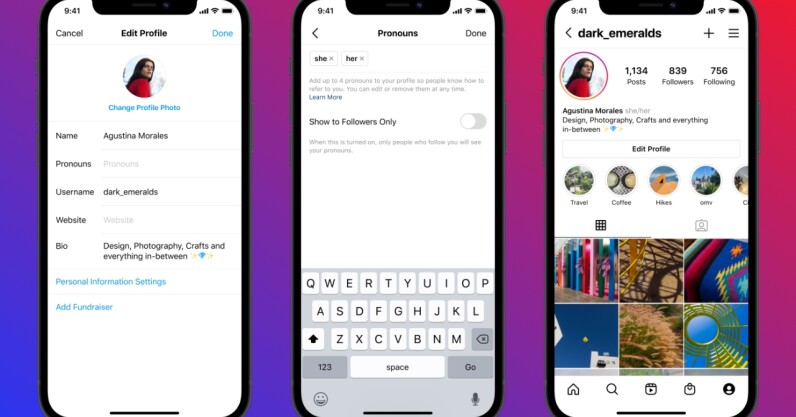
Instagram is adding a new field in your profile to display your pronouns if you wish. Until now, you could only ever key them somewhere into your bio, or include them in your display name. The company said that this feature is rolling out for users in a few countries without specifying which ones. If it’s available in your region, you’ll be able to add pronounce by heading to Edit Profile > Pronouns. You can choose up to four pronouns to write in the field. [Read: This dude drove an EV from the Netherlands to New Zealand — here are his 3 top…
This story continues at The Next Web
Or just read more coverage about: Instagram
Takeaways: There are no easy solutions to shoring up U.S. national cyber defenses. Software supply chains and private sector infrastructure companies are vulnerable to hackers. Many U.S. companies outsource software development because of a talent shortage, and some of that outsourcing goes to companies in Eastern Europe that are vulnerable to Russian operatives. U.S. national cyber defense is split between the Department of Defense and the Department of Homeland Security, which leaves gaps in authority. The ransomware attack on Colonial Pipeline on May 7, 2021, exemplifies the huge challenges the U.S. faces in shoring up its cyber defenses. The private…
This story continues at The Next Web

Another year, another set of chips by Intel. The company today announced its 11th-gen H-series chips — codenamed Tiger Lake-H — which the company claims offer up to a 19% speed boost over the prior comet lake technology. The H-series chips are normally found in larger gaming and desktop-replacement laptops, so it’s a welcome improvement. The jump in performance isn’t exactly a huge surprise; Intel is moving from a 14nm architecture to a 10nm one, so the improvements are to be expected. Still, it’s a relief, as Intel’s H-series chips had been stuck at 14nm since way back with 2015’s…
This story continues at The Next Web
Or just read more coverage about: Intel
Back in the 1960s, The Rolling Stones sang about a poorly kept secret in their hit single “Mother’s Little Helper.” Hint: Suburban housewives were popping tons of tranquilizers. Since the pandemic broke out last spring, Instagram has been rife with posts tagged with “#daydrinking” and captions like “Chardonnay o’clock,” with multi-tasking parents sharing their boozy…Read More
The Hong Kong Ballet likes to mess with tradition, pulling its classically trained dancers out of their staid performance halls and tossing them onto bustling city streets to star in eye-catching ad campaigns. The latest entry in the brand’s visually stunning oeuvre features a dream-within-a-dream that embeds the dancers in a cyberpunk urban landscape with…Read More