This CMO-first digest is the latest offering in ADWEEK’s Marketing Vanguard franchise: a collection of invitation-only events, including our signature Inspiration Excursions and annual Summit; our weekly Marketing Vanguard podcast; our annual Marketing Vanguard Awards list; and curated content and dialogs, with membership at the center.Read More
A week that spanned semiconductor physics, orbital logistics, defence interceptors, and carob-based chocolate tells you something about the breadth of European and European adjacent capital right now. The dominant thread is not a single sector but a single instinct: back the infrastructure layer, whether that means chip interconnects, satellite transfer vehicles, or the AI plumbing […]
“The odds of winning the lottery are the same whether you buy a ticket or not.”
This seems nonsensical at first. Obviously, there are lottery winners. Therefore, the odds aren’t the same.
Except we’re not mathematicians doing a math problem (at least most of us). Odds are how we navigate the world. When they’re sufficiently low, the useful approach is to assume that they’re zero. Sort of how we deal with invisible signals: There’s sound in a very quiet room, but we can’t hear it. There’s light in a very dark room, but we can’t see it. These never go to zero, but we treat them as if they do.
The story of playing very long odds might give you hope or solace or energize you. That’s what they make movies about, after all. But in practice, you’re buying that story, not a useful chance of winning something.
Paul McGowan points out that the difference between a $500 stereo and a $5000 stereo is enormous. But the difference between the more expensive stereo’s sound and one costing $50,000 is vanishingly small… Soon it becomes a story, not a sound.
Buy the best story you can afford, with all the benefits it comes with. But don’t be confused by the odds or tiny differences. They’re probably zero.
Every co-founder Elon Musk recruited to build xAI has now reportedly left the company. Manuel Kroiss, who led the pretraining team, told people this month that he was departing. Ross Nordeen, described by Business Insider as Musk’s “right-hand operator,” left on Friday. They were the last two of eleven co-founders, all of whom have exited […]
Meta is preparing to launch two new Ray-Ban smart glasses models designed specifically for prescription wearers, according to a Bloomberg report published on Thursday. The models, codenamed Scriber and Blazer, were first spotted in Federal Communications Commission filings and are expected to reach consumers as early as next week. They do not represent a new […]
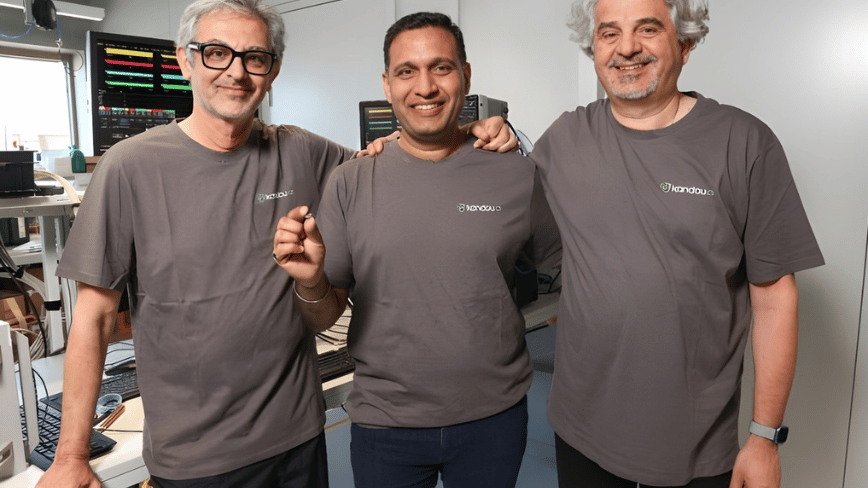
Kandou AI, a Swiss semiconductor company that builds chip-to-chip interconnect technology, has raised $225 million in what it calls a Series A round, led by Maverick Silicon with strategic participation from SoftBank, Synopsys, Cadence Design Systems, and Alchip Technologies. The round values the company at $400 million. The label is worth pausing on: Kandou was […]
Three frenetic days at Shoptalk revealed tons of anxieties about the future of commerce—from uncertainty around what it will look like, big questions at companies like Home Depot and Stratacache, and big plays from powerhouses like Google and Meta.Read More
The class of 2025 graduated into the worst entry-level job market in five years. Now a growing number of them are using AI tools during live job interviews, and a cottage industry of startups is rushing to sell them the means to do it. Whether that constitutes cheating or common sense depends on which side […]
After months of fighting to get the city council to put a stop sign on the corner of the dangerous intersection near his home, he simply did it himself. A first-rate, professional job that cost more than $1,000. As he was finishing the job at 1:30 am, he was arrested and charged with a felony.
A hundred years ago, the default was that pedestrians were in charge. Cars were guests, only going where they were invited. But the persistent productivity and cultural force of the automobile carried the day, and the default flipped. The roads must roll.
If it can be paved or straightened or sped up, it is. If the car wants it, the answer is “yes.”
80,000,000 people have died as a result of automobiles over time. (It’s harder to estimate how many lives were saved or enriched by this massive shift in the transport of food, people and resources.) A successful system can redraw our maps and our expectations.
When systems gain momentum like this, it’s because they create urgent and immediate value, enough to disrupt the status quo. And once the status quo has changed, the momentum becomes normal, the way things are, until persistent community action (or another, even more relentless system) changes the defaults.
The system doesn’t care about Joseph Brandlin’s kid. It cares about the flow and the status of those that maintain that flow.
Ironically, his arrest is almost certainly going to result in a stop sign being installed. Using one system (the media) to change another.
We’re all living through the biggest and fastest systemic shifts in a century, whether we want to or not. The internet, healthcare, the aging of populations and now, particularly, AI–they’re changing defaults. It’s possible (even likely) that individuals will go out in the middle of the night and seek to change something in their neck of the woods, but as we’ve seen with system change before, that’s not usually the reliable path to make a lasting impact.
Every system eventually acts as if it’s more important than the people it was built to serve. HAL isn’t going to open the pod bay door merely because you insist. But persistent systemic action often bends the system toward better. And better is up to us.